
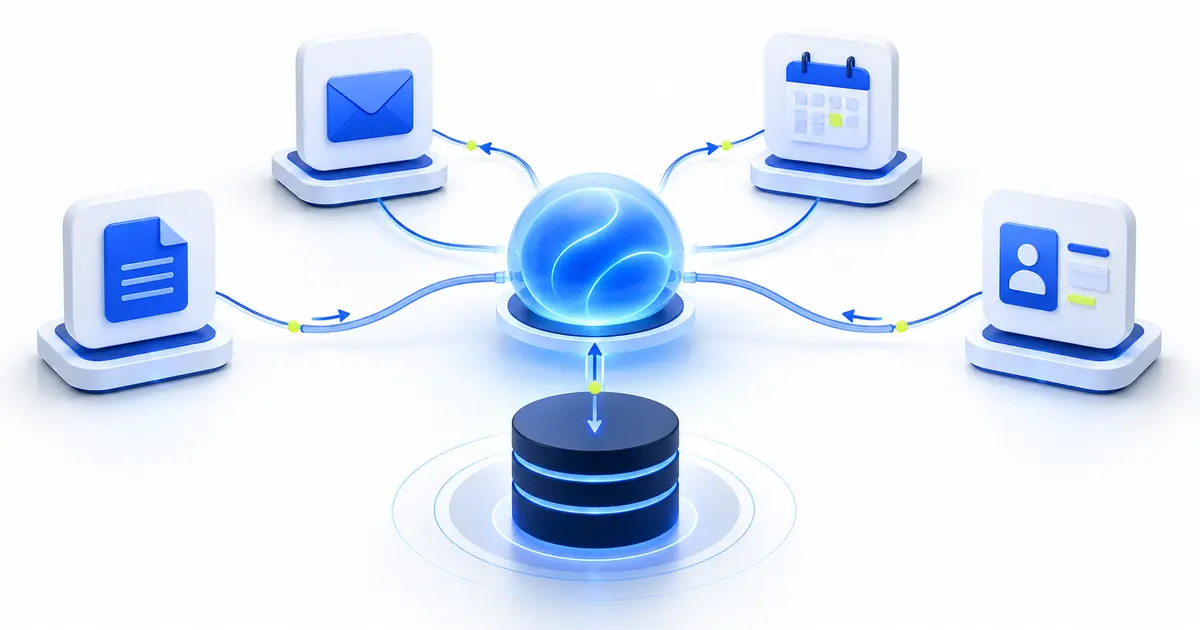
If one AI agent can read email, update documents, schedule meetings, and work across business systems, where should the final version of a decision live? That question becomes operationally important before the agent handles its first real workflow.
On October 8, 2026, Google Cloud introduced the Gemini agent, which it describes as a universal agent for work. Google says it can plan tasks, use tools, connect to company systems, and return finished work inside documents, inboxes, and developer environments. Reuters independently reported that it works across Google Workspace and can also be used through Microsoft 365 and Slack. The agent is currently in private preview for enterprise customers, according to The Verge.
Those are the reported capabilities. My practical takeaway is that cross-app reach creates a coordination problem: the same task, date, client status, or approval can exist in several places. Without a source-of-truth rule, an agent can make every system look updated while leaving the team unsure which record is authoritative.
Assign one system to each type of truth
Create a short map before connecting the agent. Calendar events belong in the calendar. Action ownership and deadlines belong in the project tracker. Client stage, contact history, and next step belong in the CRM. Approved working documents belong in the document repository. Formal approvals belong in the system that records the approver and timestamp.
Email and chat are useful inputs, but they are usually poor final records. If a client changes a deadline in an email, the agent may summarize the message, update the project task, and note the change in the CRM. The task tracker remains the authority for delivery timing.
Separate reading from writing
An agent may need broad read access to understand context while having narrow write access to protect reliable records. For each connected app, list whether the agent may read, draft, create, edit, or delete. Do not treat “connected” as a single permission.
I would begin with draft-only behavior for external messages and write access only for reversible internal updates. Client commitments, payments, deletions, access changes, and contract terms should require a person.
Define the order of operations
Cross-app work needs a sequence. For a rescheduled client call, the agent might first confirm the requested time, check conflicts, prepare the calendar change, draft a reply, and update the task only after approval. If one step fails, later updates should pause instead of creating conflicting records.
The workflow should also be idempotent: running it twice must not create two meetings, duplicate tasks, or repeated customer messages. Use stable task IDs and check the authoritative system before creating anything new.
Keep a compact change receipt
Google says its enterprise controls include agent identity, permissions, and audit trails. Teams should turn those logs into a readable receipt: what triggered the work, which systems were read, what changed, what failed, and which actions still need approval.
A receipt is especially useful for remote teams because the next person can understand the current state without reopening every app. It also makes corrections faster when an agent follows an outdated instruction.
Test with conflicting information
Do not test only clean demonstrations. Put one deadline in email, another in a task, and an older one in a document. The agent should follow the declared source of truth, flag the conflict, and avoid silently blending the values.
A universal work agent may reduce app switching, but it does not remove process ownership. The strongest setup is not the one with the most connections. It is the one where every important fact has one clear home, every write has a boundary, and every change can be reviewed.
Sources and further reading
- Google · Google Cloud introduces the Gemini agent · October 8, 2026
- Google Cloud · Gemini at Work 2026 · October 8, 2026
- Reuters · Google Cloud introduces Gemini agent for work · October 8, 2026
- The Verge · Google launches a one-stop Gemini agent · October 8, 2026
Product capabilities and enterprise controls are attributed to Google; Reuters and The Verge independently reported the launch and preview status. The source-of-truth framework is my practical interpretation for operations teams.
Related: how I structure quality checks and escalation, operations and client support, and more Daily Blogs.