
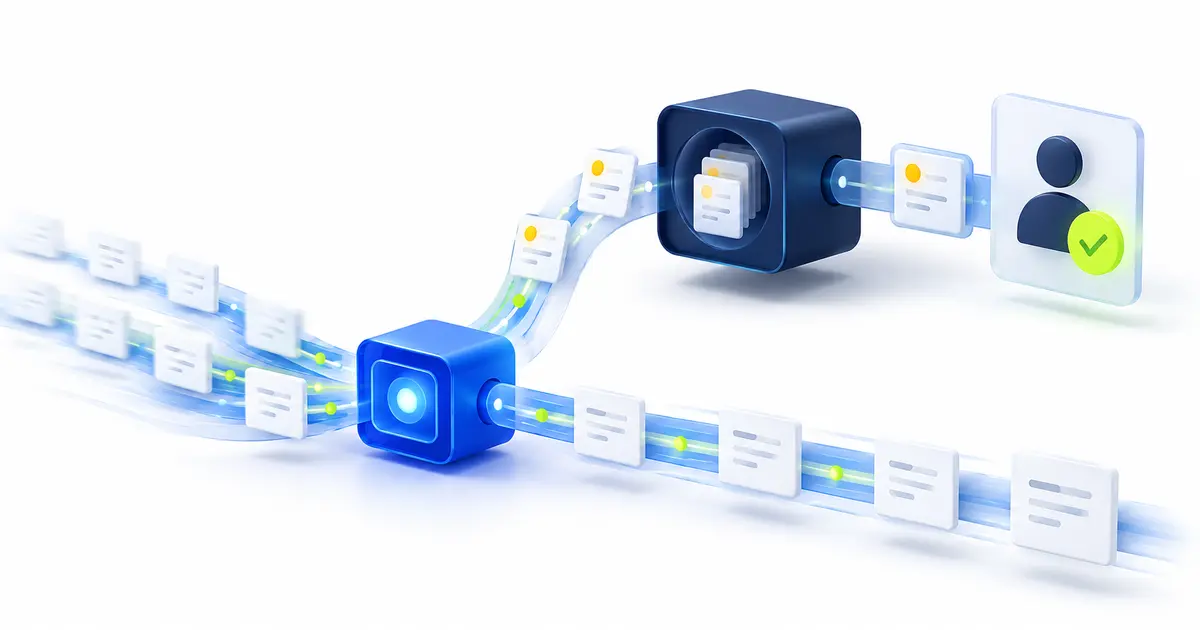
Should every AI task use the most capable model available? Anthropic’s latest launch makes the opposite case: many repetitive jobs may be better served by a smaller, faster model—if the team sets clear routing and escalation rules.
On October 7, 2026, Anthropic released Claude Haiku 5.5, describing it as its fastest and least expensive small model. The company positions it for high-volume work such as summaries, classification, database queries, browser use, and live customer support. Reuters independently reported the launch as the third model in Anthropic’s Claude 5.5 family.
Anthropic says Haiku 5.5 costs about 75% less to run on average than Haiku 4.5, based on its pricing and typical request mix. That is a vendor calculation, not a guarantee for every workload. My practical takeaway is not “use this model everywhere.” It is to route work according to complexity, risk, and evidence.
Route narrow, repeatable tasks first
A small model is a sensible candidate when the input format, expected output, and correct answer are easy to define. Examples include tagging support tickets, extracting fields from approved documents, producing a first summary, checking whether required information is present, or drafting an internal status note.
Each task should have a written definition of success. If the team cannot explain what a correct result looks like, it cannot reliably test whether a faster model is good enough.
Keep uncertain work on an escalation path
The model should not be forced to answer every request. Add conditions that route work elsewhere: missing source data, conflicting instructions, low confidence, unusual customer language, regulated information, large financial impact, or an action the system cannot reverse.
Escalation may mean a stronger model, a specialist queue, or direct human review. The important part is that the workflow records why the task moved and who owns the next decision.
Test complete tasks, not attractive demos
Anthropic published benchmark and customer results, but teams should run their own evaluation using real examples. Build a small set containing normal cases, edge cases, incomplete inputs, and past mistakes. Compare accuracy, false positives, response time, cost per completed task, and the amount of human correction required.
I would avoid measuring only token price. A cheap answer that creates rework, delays a customer, or changes the wrong record can be the most expensive option.
Use different routes inside one workflow
A single process can combine several levels of intelligence. A small model may classify an incoming request and extract facts. A stronger model may analyze an unusual case. A person may approve the final commitment or external message.
This design keeps routine work fast without pretending every task has the same risk. It also makes performance easier to diagnose because each step has a defined responsibility.
Review the route as volume changes
Track exceptions, corrections, escalations, latency, and cost weekly. If too many items escalate, the task definition may be unclear. If errors cluster around one client or document type, create a separate route rather than weakening the rule for everyone.
Smaller models can make automation more practical at scale. The operational advantage comes from disciplined routing—not from choosing the cheapest model and hoping it knows when to stop.
Sources and further reading
- Anthropic · Introducing Claude Haiku 5.5 · October 7, 2026
- Reuters · Anthropic launches third Claude 5.5 model · October 7, 2026
Availability, pricing, benchmarks, and customer tests are reported by Anthropic; Reuters independently confirmed the launch. The routing and escalation framework is my practical interpretation for operations teams.
Related: how I structure quality checks and escalation, operations and client support, and more Daily Blogs.