
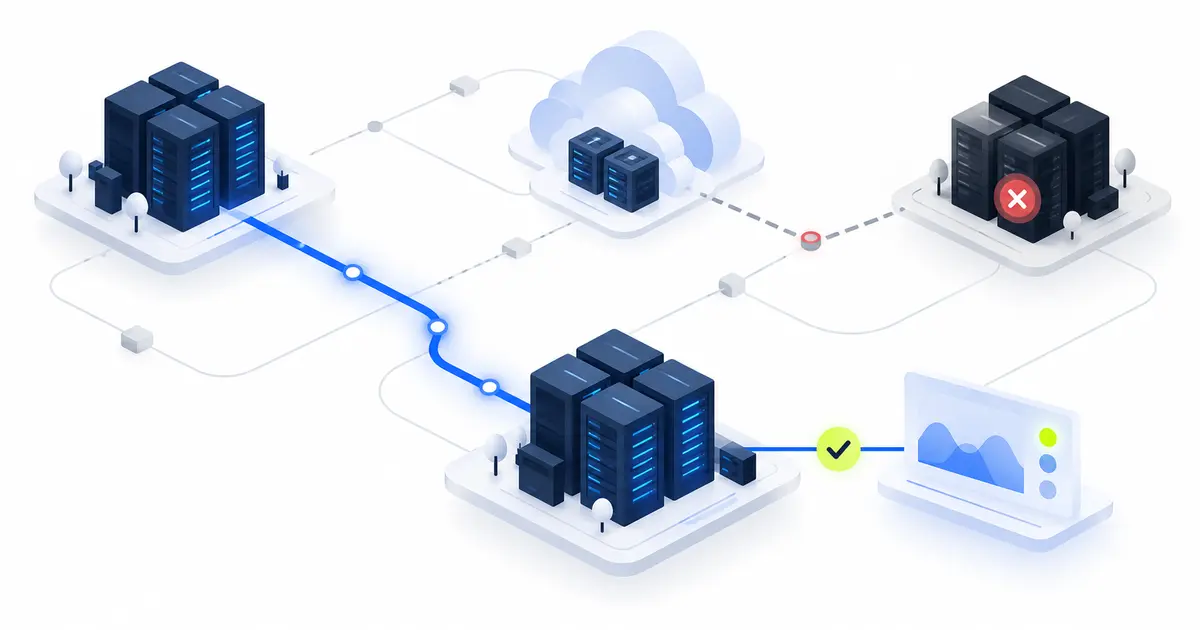
If the infrastructure behind an AI service suddenly disappeared, which client and internal workflows would stop first? That question became concrete on October 11, 2026, when Reuters reported that damage from a drone attack caused the complete shutdown of a Yandex data centre in Russia’s Vladimir region. The company said some services were unavailable and no one was injured.
Reuters described this as the third major Yandex data-centre disruption in several days. It previously reported that the Sasovo hub had been shut down and that another facility in Kaluga was partly out of action. Two of Yandex’s three supercomputers used for AI-model development were housed at Sasovo, although Reuters said Yandex had not confirmed whether those machines were damaged.
Yandex’s October 9 statement confirmed the earlier Sasovo and Kaluga incidents, said teams were working to keep services running, and warned that restoration timing was difficult to estimate. The physical and geopolitical circumstances are unusual, but the operations lesson is broad: an AI workflow can depend on concentrated infrastructure even when the interface feels like an ordinary cloud service.
Map the full dependency chain
For each important workflow, list the model provider, cloud region, vector database, identity service, document store, automation platform, and messaging channel it needs. Add the business owner and the maximum acceptable downtime. A second model is not a useful fallback if it still depends on the same region, credentials, or data source.
I would start with workflows that affect client communication, payments, scheduling, customer support, or regulated records. Those usually need clearer recovery expectations than drafting or brainstorming.
Define a useful degraded mode
Decide what the team can still deliver when the main AI service is unavailable. Customer support might switch from generated replies to approved templates. A document workflow might preserve intake and queue processing for later. A sales assistant might keep contact records while pausing enrichment.
Write the reduced service as a short promise: what remains available, what pauses, who approves exceptions, and how clients are informed. This prevents people from improvising different answers during an outage.
Separate regional failover from vendor failover
Regional failover keeps the same service running elsewhere. Vendor failover moves the task to another provider. Test these as different procedures. Regional recovery may preserve features and data formats, while a vendor switch can change output quality, security terms, latency, and review requirements.
For both paths, keep a small evaluation set and expected results. That gives the team evidence that the backup can perform the essential task rather than merely produce an answer.
Protect the recovery path
Store runbooks, emergency contacts, clean configuration copies, and recovery credentials somewhere that does not depend on the failed system. Use least-privilege break-glass access, record when it is activated, and rotate credentials afterward. Confirm that status updates can still reach staff if the normal collaboration tool is affected.
Run a timed exercise
Once a quarter, simulate the loss of the primary AI service for one critical workflow. Measure detection time, decision time, recovery time, missing data, and manual effort. Then update the runbook and assign each unresolved gap to one person.
My practical takeaway is that continuity is an operating capability, not a backup checkbox. Teams need to know what fails together, what service they can maintain, which recovery route is independent, and who has authority to activate it. The best failover plan is the one people have actually used under a clock.
Sources and further reading
- Reuters · Yandex says Vladimir data centre shut down after drone attack · October 11, 2026
- Yandex · What is happening to our data centers · October 9, 2026
- Reuters · Yandex says restoration prospects remain unclear · October 8, 2026
- AFP · Yandex data-centre operations disrupted · October 11, 2026
Incident facts are attributed to Yandex, Reuters, and AFP. The continuity framework is my practical operations interpretation.
Related: how I document operational ownership, testing AI stack portability, and more Daily Blogs.